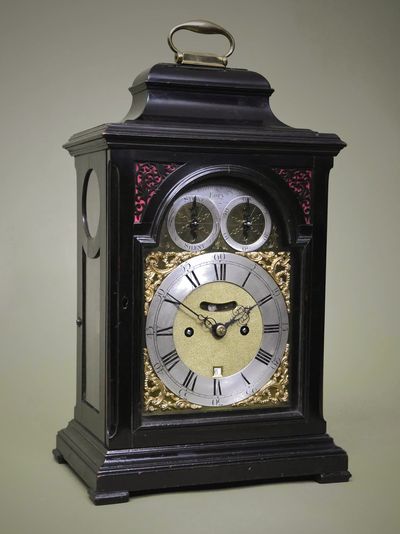
Antique Bracket Clock by William Nicoll, Edinburgh
William Nicoll - Edinburgh
A well-proportioned bell top bracket clock in an ebonised case, featuring a two train 8 day fusee mechanism and verge escapement. This exquisite timepiece strikes the hours on a single bell and also offers pull repeat and strike/silent functions, adjusted via one of the sub dials in the arch of the dial. The remaining sub dial provides rise and fall regulation. A real showcase of the meticulous craftsmanship typical of Edinburgh clocks.
The classic style of the ebonised case reflects the period's elegance, with a curved bell top, ebony frets on the front glazed door, a brass carrying handle, and ebonised feet. The brass dial is beautifully accented with gilded spandrels in the corners, a silvered chapter ring, subsidiary dials, and a cartouche. The matted center includes an aperture for the date observed above VI. The backplate is elaborately engraved with leaves, flowers, and hoho birds, a testament to the craftsmanship during this period.
£8500
Dimensions: 19"x 11.5"x 8"
Booked apprentice to Patrick Gordon in 1740, he compeared on 4th June 1748, presenting a bill to be admitted as a freeman clock and watch maker. On 16th Sept. 1748, he presented his essay: a plain eight-day clock, which was deemed a well wrought piece. His essay masters included John Brown, Alexander Brand, and William Richardson. Notably, his essay was crafted in his own shop, under the guidance of Patrick Gordon, landlord. E. H. Records.
(An extract from John Smith's "Old Scottish Clockmakers from 1453 - 1850")